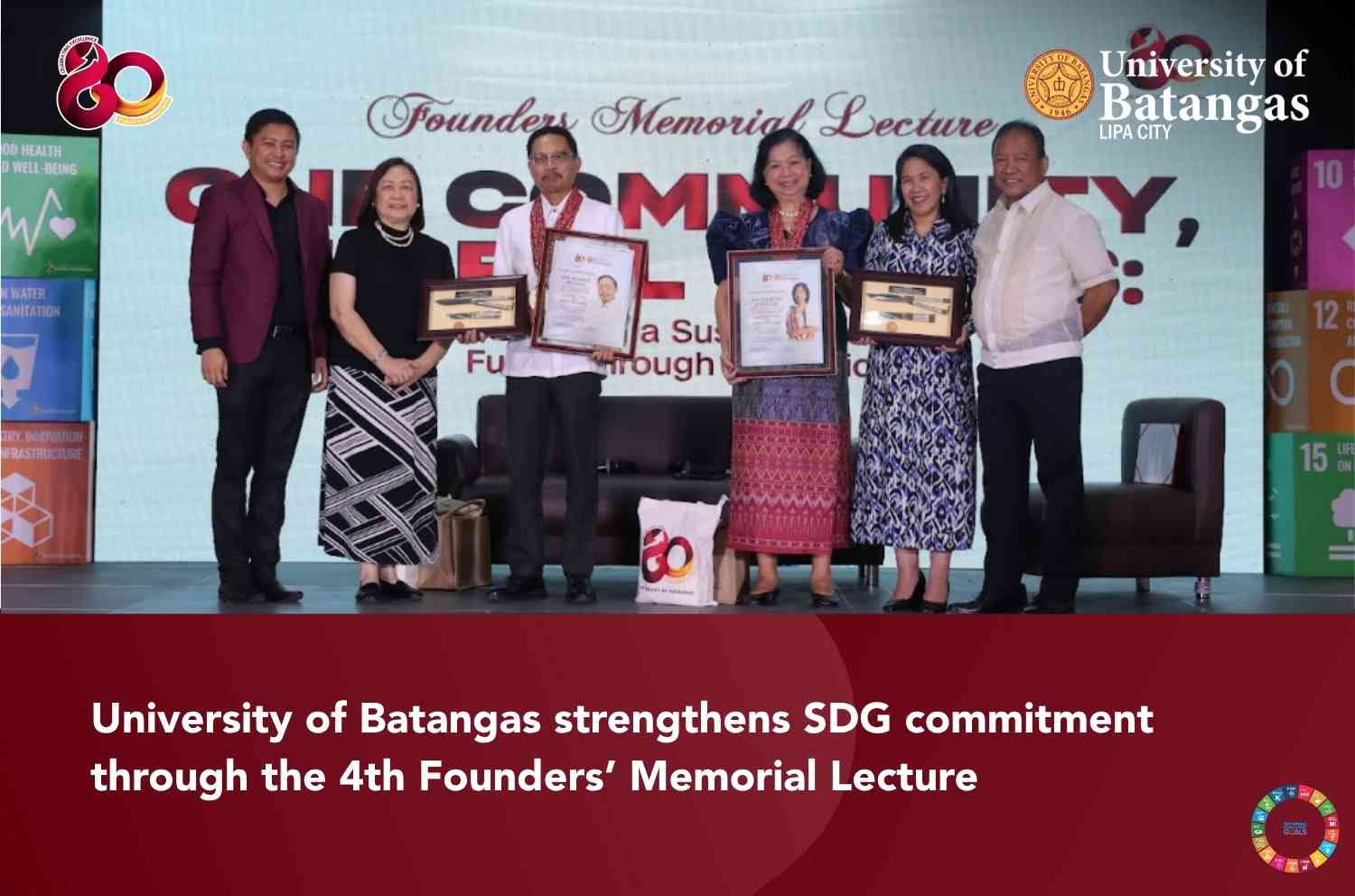
Eight decades after its founding, the University of Batangas Lipa City (UBLC) transformed its 80th Founding Anniversary celebration into a forward-looking academic convergence through the 4th Founder’s Memorial Lecture Series held on May 14, 2026 at the UBLC Multipurpose Hall, anchored on the theme “One Community, Global Goals: Building a Sustainable Future Through Education.” The event brought together university administrators, faculty members, and industry partners in a shared reflection on the evolving role of education amid global challenges aligned with the Sustainable Development Goals.
In her welcome remarks, University President Lily Marlene J. Hernandez-Bohn emphasized the institution’s enduring foundation, stating, “Moments like this invite us not only to gather as an academic community, but also to reflect on the foundations upon which our institution was built… Foundations shaped by vision, sacrifice, and a strong belief in the power of education,” highlighting UBLC’s continuing mission to shape learners as active contributors to global transformation. The lecture series further positioned education as both legacy and responsibility, reinforcing its role as a strategic platform for developing critical thinking, empathy, and civic responsibility in addressing interconnected social, economic, and environmental concerns.
In his opening spiel, Dr. Carl Ivan Villanueva, Director of UB Distance Education and Master of Ceremony, underscored the urgency of rethinking the role of education in society, stating that, “Education is often framed as a mirror reflecting the current state of our society. But I prefer to look at it as a window. One we must throw wide open to let the future in.” He cited findings from EDCOM 2, noting the country’s severe learning crisis and the mismatch between academic outputs and industry needs, alongside global data indicating that only about 15% to 30% of SDG targets are currently on track toward 2030.
While acknowledging the scale of these challenges, he stressed that UBLC and the academe must act as “engines of national development,” emphasizing that aligning curricula with global standards allows institutions to contribute not only to local progress but also to global SDG acceleration.
The discourse deepened through the keynote of Hon. Ricarte B. Abejuela III, Director of United Nations and International Organizations under the Department of Foreign Affairs, in his topic “SDG Synergy: Building Sustainable Futures Through Education,” where he urged academic stakeholders to act decisively, declaring, “We must move beyond the luxury of privileged seclusion. The real world is not waiting for you to graduate; it is happening right now outside these walls. Education is the vehicle, the Sustainable Development Goals are the roadmap, but your passion is the fuel.”
He reflected on a phrase commonly heard in Filipino households – “Anak, edukasyon lang ang tanging maipamana ko sa inyo.” He emphasized that this is not merely a cliché but a socio-economic reality, as education remains the most enduring inheritance for Filipino families, one that cannot be stolen, destroyed by calamities, or taken away. For many, it serves as the ultimate equalizer and pathway to a better life.
However, he stressed that in 2026, education can no longer be viewed solely as preparation for employment. In an era of poly-crisis, global disruptions such as geopolitical conflicts affecting fuel prices or health emergencies impacting economies demonstrate how interconnected the world has become. Thus, education must go beyond personal advancement and shape learners into architects of a better society.
He further urged the Filipino youth to help translate the Sustainable Development Goals (SDGs) into local reality, emphasizing that education must evolve from pag-aaral (schooling) into pagkatuto (lifelong learning). He identified three essential dimensions of true education: critical thinking in the age of misinformation and AI; cultivated empathy for marginalized sectors; and the willingness to act, stressing that knowledge without action is merely trivia.
Abejuela also framed sustainable development as becoming a “good ancestor” meeting present needs without compromising future generations. He explained its three pillars: economic growth, social inclusion, and environmental protection, likening them to a tripod where each leg is essential. He emphasized inclusivity “walang iwanan” and environmental responsibility, warning that resources are limited and must be preserved for future generations.
He traced the evolution of global sustainability efforts from the 1987 Brundtland Report (Our Common Future), the 1992 Earth Summit, Agenda 21, the Millennium Development Goals (MDGs), and the current 17 Sustainable Development Goals (SDGs) adopted in 2015 for achievement by 2030. While noting Philippine progress in areas such as responsible consumption, poverty reduction, and clean energy, he acknowledged persistent gaps in health, education quality, and water sanitation.
He stressed that Quality Education (Goal 4) is central to achieving all other SDGs, as it enables literacy in health, governance, environmental responsibility, and social equity. He also challenged the “ivory tower” mindset in higher education, urging universities like UBLC to become active development hubs and “living laboratories” for sustainability through practical, community-based initiatives.
In closing, he called on students to take active roles in localizing the SDGs through innovation, volunteerism, advocacy, and accountability. He encouraged the use of digital platforms for awareness and community engagement, reminding the youth that they are not only the hope of the future but also agents of change today. He concluded with a challenge: “If not me, who? If not now, when?”
Reinforcing this global-local continuum, Her Excellency the Philippine Eminent Person to the High-Level Task Force on the ASEAN Community’s Post-2025 Vision of the Department of Foreign Affairs, Ambassador Elizabeth P. Buensuceso , in her topic “Foreign Policy, Diplomacy, ASEAN and Me,” highlighted diplomacy as a shared responsibility that brings international relations closer to the individual level through the “me, you, and us” lens. She emphasized that every Filipino is a stakeholder in regional progress, especially as ASEAN cooperation strengthens in 2026, calling for unity in diversity not merely as a slogan but as a lived practice of collaboration, shared identity, and collective responsibility.
She also encouraged students to consider careers in the Philippine Foreign Service, citing the legacy of Batangueño diplomacy through figures such as Apolinario Mabini and other distinguished diplomats from Batangas, underscoring that diplomacy is both a profession and a form of public service grounded in nation-building. She explained that foreign policy is anchored on national interest as defined by Philippine laws and institutions, while diplomacy serves as its practical expression through negotiation, cooperation, and dialogue.
Distinguishing the two, she described foreign policy as the “principles and direction” of a state, while diplomacy is its “execution in action,” stressing that effective engagement requires negotiation skills, cultural sensitivity, and strategic thinking. She further highlighted that Philippine foreign policy is guided by three pillars: political security, economic diplomacy, and the protection and welfare of Filipinos overseas, reflecting the country’s unique global responsibility to its citizens.
She emphasized that ASEAN remains vital in maintaining regional peace and stability for nearly six decades, preventing conflict escalation in a highly diverse region marked by historical, cultural, and political differences. Through the principle of consensus, ASEAN fosters cooperation grounded in dialogue rather than confrontation, ensuring that member states pursue shared progress while respecting sovereignty and diversity.
She further underscored ASEAN centrality as a guiding principle that positions the region as the “driver’s seat” in managing regional cooperation, shaping agendas, and strengthening unity amid global power rivalries. In closing, she called on the academe and the youth to deepen ASEAN awareness, engage in cultural and academic exchanges, and recognize themselves as active contributors to a shared regional future where unity in diversity becomes a lived reality rather than an abstract ideal.
As the plenary session drew to a close, Mr. Ethan Joshua Ramos, Learner and Faculty Support Head, emphasized that the lecture series redefined the concept of community beyond geography into a moral and civic responsibility. He noted that the SDGs serve as an interconnected blueprint for survival and dignity, where progress in one goal affects all others, especially in an era marked by poly-crisis.
He further stressed that education remains the Philippines’ most vital inheritance, extending beyond degrees into lifelong learning rooted in “pagkatuto” and collective wisdom for the common good.
Culminating the program, Atty. Jesus V. Mayo, Chairman of the Board of Regents, reaffirmed UBLC’s institutional mission, stating, “May we remain guided by the wisdom and grace of our Almighty God, whose blessings empower us to overcome challenges and faithfully fulfill our mission.”
As UBLC advances beyond its 80-year milestone, the lecture series stands as a reaffirmation that the university is not merely preserving its legacy but actively shaping learners into “good ancestors” committed to inclusive, resilient, and sustainable futures, where education serves as both bridge and engine for global transformation from 1946 to the present and beyond.