
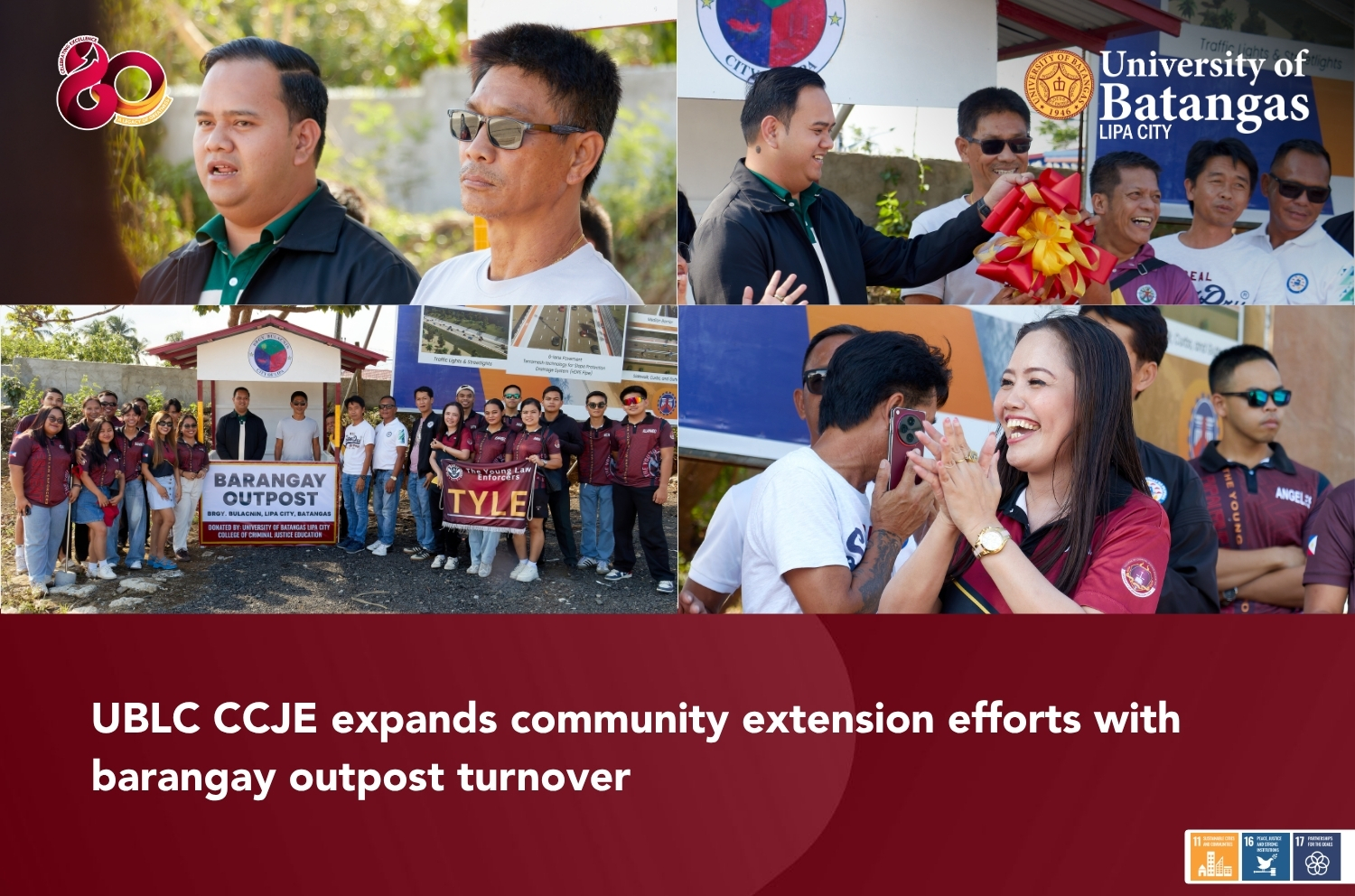
The University of Batangas Lipa City College of Criminal Justice Education (CCJE), through its student organization The Young Law Enforcers (TYLE), officially donated a barangay outpost to the university-adopted community, Barangay Bulacnin, Lipa City, as part of its continuing Community Extension Services (CES) initiatives. Installed along the newly opened and operational five-kilometer Bulacnin–Mataas na Kahoy Bypass Road connecting Lipa City and the municipality of Mataas na Kahoy, Batangas, the outpost aims to support the barangay’s public safety efforts, strengthen community accessibility, and provide an additional facility that may be utilized for community monitoring and future extension-related activities. The initiative reflects the college’s commitment to community engagement and its continuing efforts to extend meaningful and sustainable services beyond the university through collaborative and people-centered programs.
Present during the turnover ceremony were Barangay Chairman Hon. Frederick D. Ramirez together with members of the barangay council, who welcomed the initiative and expressed appreciation for the university’s continued partnership with the community. Representing the university were Dr. Glenn R. Aguila, Dean of the College of Criminal Justice Education; Mr. Apolinario Maranan, External Programs Coordinator; Dr. Jovi Jane Bernales, CES Coordinator of the College of Criminal Justice Education; Ms. Angelica Arianne Castillo-Atienza, TYLE Adviser; Ms. Lycka R. Marco, College Secretary; and students from the CCJE who actively participated in the implementation of the project. The presence of university officials, faculty members, student leaders, and barangay representatives highlighted the strong collaboration between the academic institution and the local government unit in promoting programs that directly benefit the community.
In his remarks, Hon. Ramirez conveyed his gratitude to the university for selecting Barangay Bulacnin as one of its partner communities and for continuously initiating projects that contribute to the welfare and development of the barangay. He assured the university that the Sangguniang Barangay remains supportive and open to future collaborations, programs, and endeavors that will further strengthen community relations and provide opportunities for residents and students alike. He also emphasized the importance of partnerships between educational institutions and local communities in creating programs that address real community needs while fostering civic responsibility among students.
Meanwhile, Dr. Aguila underscored the significance of the project as a product of collective effort and shared commitment among the students, faculty members, staff, and the partner community. He expressed his appreciation to everyone involved in making the initiative possible and emphasized that the outpost will not only benefit the residents of Barangay Bulacnin but will also serve as a practical support facility for future internship programs, field activities, and community immersion initiatives of the CCJE. He added that projects such as this allow students to gain a deeper understanding of public service, community relations, and the role of criminal justice education in nation-building while giving the university an avenue to extend relevant and impactful services to the community.
Through this initiative, the CCJE continues to set a high standard in community extension services by implementing programs that create direct and lasting impact on partner communities. The barangay outpost project also reflects the university’s commitment to the United Nations Sustainable Development Goals (UNSDGs), particularly Goal 11 on Sustainable Cities and Communities, Goal 16 on Peace, Justice, and Strong Institutions, and Goal 17 on Partnerships for the Goals. By strengthening collaboration between the university and the local community, the initiative reinforces the importance of shared responsibility, active citizenship, and sustainable partnerships in promoting safer, more inclusive, and service-oriented communities.