
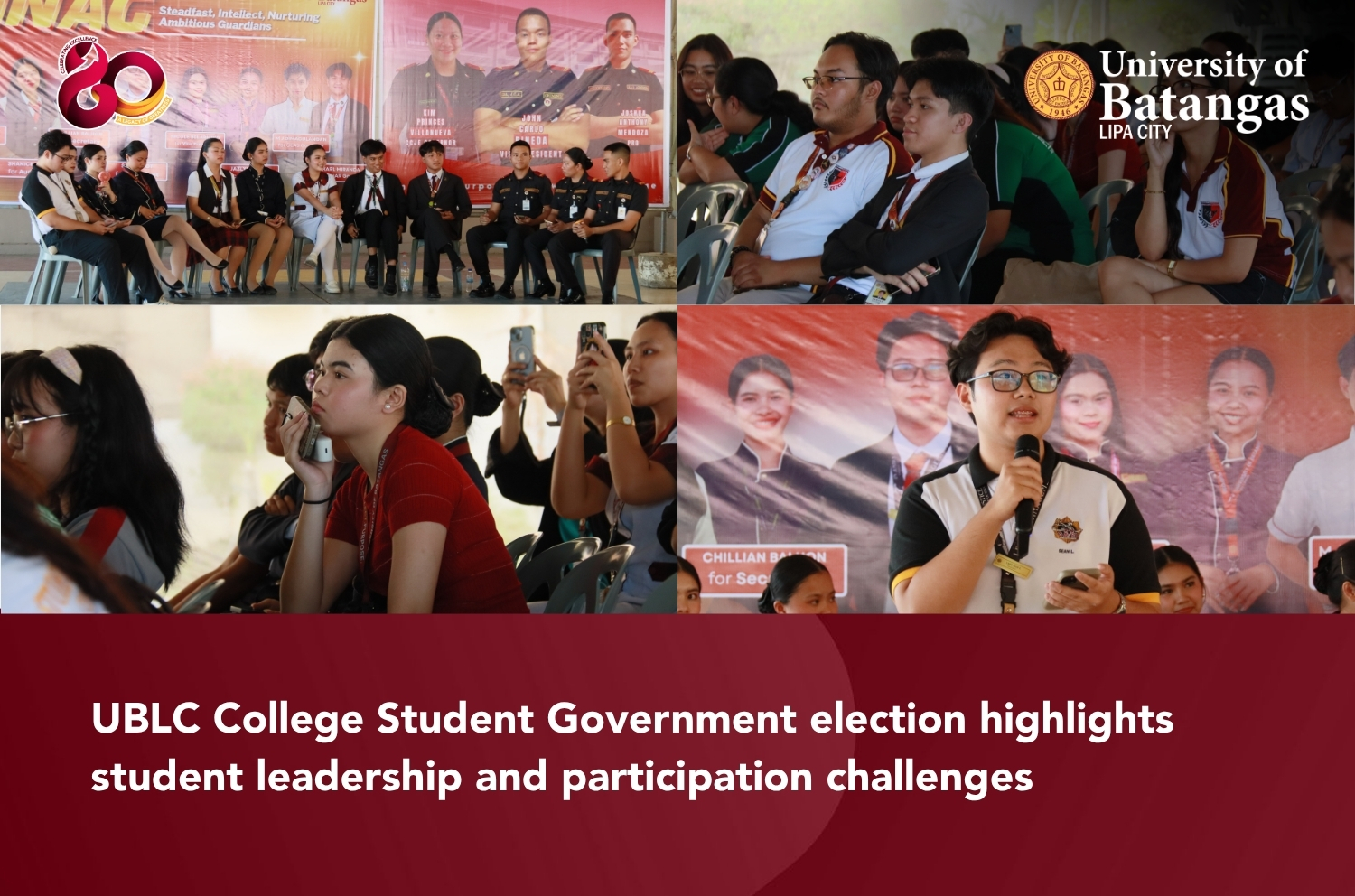
In a democratic institution such as colleges and universities, students are entrusted with the opportunity to elect representatives who will champion their ideals, advocate for their rights, and help improve systems within the modern learning environment. Elections serve as a formal decision-making process in which members of a community choose individuals to assume positions of responsibility through collective voting.
However, what becomes of an election when the very decision-making body begins to abstain from exercising this right?
The College Student Government (SG) of the University of Batangas Lipa City (UBLC) prepares to elect a new set of student leaders tasked to embody the aspirations of the student body, represent collective concerns, and engage the administration in future institutional dialogues and policy discussions affecting campus life.
According to information compiled and released by The Brahmans’ Journal, the official student publication of UBLC, the official campaign period ran from April 20 to 29, followed by the Miting de Avance on April 30, which gathered hundreds of students at the university to witness candidates present their platforms and leadership intentions. Election precincts were scheduled on May 6 and 7, while online voting was conducted from May 8 to 9, allowing students to exercise their right to suffrage through both physical and digital participation.
Among the participating groups was SINAG (Steadfast, Intellect, Nurturing Ambitious Guardians), headed by presidential candidate Sean Laot together with nine candidates completing the party’s slate. Independent candidates also joined the electoral race, including John Carlo Pineda for Vice Presidency, Joshua Anthony Mendoza for Public Resource Officership, and Kim Princess Villanueva representing the College of Criminal Justice Education for gubernatorial post.
Thus far, no candidate filed for the College of Information Technology, Entertainment, and Communication (CITEC) Governor position, leaving the gubernatorial post vacant for the meantime. Student Affairs and External Programs Officer Mrs. Milette L. De Torres shared that the office continues coordination with CITEC to ensure representation once the newly elected Student Government convenes its first governing session.
Based on candidate platforms gathered by The Brahmans’ Journal, Presidential aspirant and second-year Bachelor of Science Legal Management student, Sean Laot emphasized student-centered leadership anchored on stronger engagement between the Student Government and the student population. His proposed initiatives include an academic resource drive that will provide verified reviewers and study materials to support students academically. He also highlighted the importance of amplifying student voices, particularly those hesitant to express concerns or participate in leadership roles, noting that many students may not yet fully understand the responsibilities associated with student governance.
Vice presidential candidate Nicole Belarmino, second-year Bachelor of Science Tourism Management student, introduced Project L.E.A.D. (Leadership, Excellence, and AI Development), which aims to deliver workshops on artificial intelligence literacy, no-code development, and digital ethics accessible even to non-technology majors. Her broader agenda includes peer support systems, organizational collaboration, sustainability initiatives, and the development of a digital transparency portal.
Secretary candidate Chillian Rose Balhon focused on improving records management and strengthening transparent communication through digital documentation systems. Treasurer candidate Jazyln Sigue proposed a cashless campus integration using e-wallet platforms to streamline student transactions while promoting student rights advocacy and mental health wellness programs. Auditor candidate Shanice Andrea Uri underscored financial accountability through strict documentation, post-event transparency reports, and student feedback mechanisms.
Departmental representation also formed a key part of the election. CENAR gubernatorial candidate Karl Angelo H. Miranda presented the UNITY, IGNITE, ELEVATE, and REPRESENT platforms aimed at enhancing inter-organizational coordination and strengthening departmental engagement. Meanwhile, College of Health Sciences (CHS) candidate Samantha Janwin Alcantara introduced Project Sync, an academic support initiative utilizing peer mentoring and curated study resources based on student learning needs. The CHS gubernatorial seat marks the first formal representation of the college within the Student Government structure.
Despite the active campaign period, concerns emerged regarding the limited number of students filing candidacies. The outgoing Student Government President Anne Marjorie Caringal, a third-year Bachelor of Science in Accountancy student, described the situation as both alarming and understandable. She explained that many capable student leaders remain hesitant to run due to the demanding nature of leadership responsibilities, extensive approval processes, and heightened visibility associated with Student Government positions. According to Caringal, students already managing heavy academic workloads often perceive leadership roles as an added burden. She further observed that declining student leadership participation appears to extend beyond UBLC, reflecting trends seen in other institutions and possibly influenced by broader social and political environments.
Reflecting on her administration’s legacy, Caringal highlighted the implementation of regular consultation sessions with organization presidents, which allowed direct dialogue, feedback exchange, and collaborative decision-making involving student organizations. She considers these consultations a source of pride for her term, strengthening communication between the Student Government and the wider student community.
Having assumed leadership following the early resignation of the elected president, Caringal encouraged future leaders and students to embrace courage despite uncertainty. She emphasized the message “faith over fear,” urging students to take steps toward leadership, overcome doubts, and believe in their capacity to grow through challenges.
In a separate interview, Mrs. De Torres noted that the Office of Student Affairs and External Programs, together with the Student Government and the colleges, continues to encourage students to participate in governance. The office works closely with deans and program heads to enhance leadership capacity-building initiatives and motivate students to serve. She added that remaining vacancies may be filled once the incoming Student Government formally organizes and begins its term.
Before the conclusion of the electoral process, the Official and Accredited Commission on Elections (COMELEC) of the Student Government released a partial and unofficial tally of votes for the ongoing College Student Government Elections as of May 8, 2026, at 5:33 p.m. Election officials emphasized that the figures remain unofficial and are subject to final validation and canvassing procedures.
Initial data reflected a voter turnout of 33.95 percent, significantly below the required participation threshold. With the turnout falling short of expectations, the University of Batangas Lipa City community may once again await official student representation at the opening of the next academic year, pending further action and possible intervention from the Office of Student Affairs and External Programs regarding the outcome of the current election cycle.
The UBLC College Student Government elections ultimately highlight both the vitality and challenges of democratic participation within academic institutions. While elections provide a structured avenue for representation, participation remains essential to sustaining meaningful governance.
Abstention in electoral processes does not only result in limited representation; it also signals the need to reassess systems supporting student leadership. It invites institutions and students alike to revisit priorities, balance academic responsibilities with civic engagement, and cultivate an environment where every student feels heard, represented, and empowered to participate in shaping the university community.
As another election cycle remains in transition and the student body awaits the final decisions arising from this process, the University of Batangas Lipa City continues its commitment to cultivating an environment where expression, leadership, and democratic participation are actively practiced. Beyond electoral outcomes, the institution recognizes that student governance serves as a training ground for responsible citizenship, collaborative leadership, and meaningful engagement within the academic community.
Amid evolving challenges in student participation, the university, together with its student leaders and support offices, sustains efforts to empower learners to take part in decision-making processes, voice their perspectives, and contribute to institutional growth. Ultimately, the strength of student democracy rests not only on elected leaders but on a community willing to participate, engage, and uphold the shared responsibility of representation in shaping a responsive and inclusive university experience.