
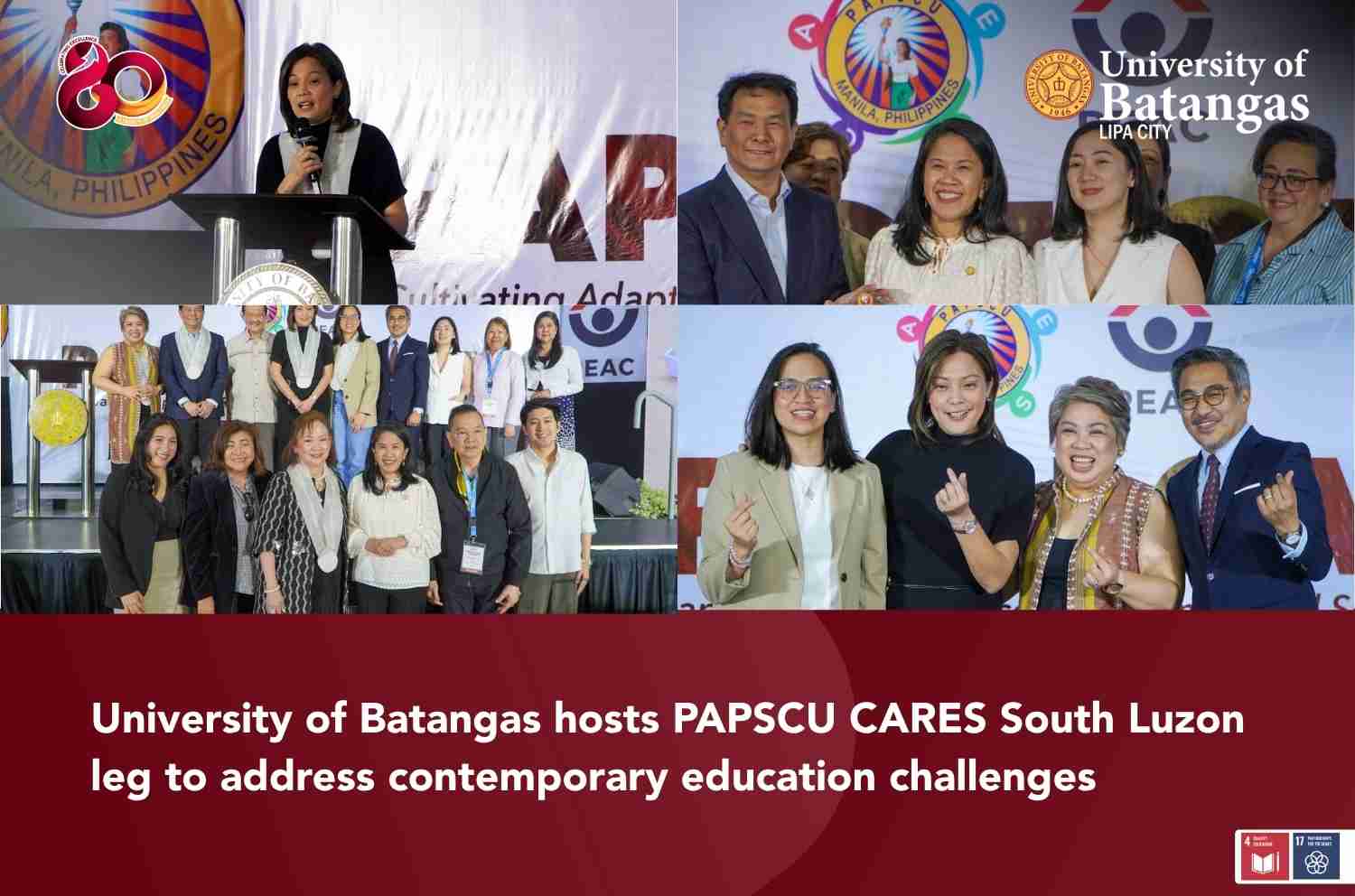
Marking a significant milestone in its 80th founding anniversary celebration, the University of Batangas Lipa City hosted the South Luzon leg of the PAPSCU CARES Education Series titled “Engaging the Next Gen Education Leaders: Cultivating Adaptability, Resilience, Excellence, and Support in Education” on April 17, 2026, at the University of Batangas Lipa City Multi-purpose Hall. The forum gathered educators, school leaders, policymakers, and industry partners from more than 100 participating institutions across CALABARZON and neighboring provinces to address contemporary challenges shaping Philippine education.
Organized by the Philippine Association of Private Schools, Colleges, and Universities (PAPSCU) in partnership with the University of Batangas, PAPSCU CARES serves as an education series and professional development platform designed to support private education institutions. The initiative promotes educator well-being, strengthens school governance, and enables benchmarking of best practices through discussions on sustainability, innovation, technology integration, legal compliance, and mental health support. The program aligns with the United Nations Sustainable Development Goals (UNSDG) 4: Quality Education and 17: Partnerships for the Goals by fostering collaborative solutions that advance inclusive and sustainable educational systems.
The South Luzon conference highlighted the urgent need for Philippine education to move beyond temporary reforms toward long-term institutional resilience. Speakers emphasized that addressing the nation’s educational challenges requires adaptive leadership, research-driven policies, strong governance, and sustained collaboration between public and private sectors.
Addressing leadership dynamics in contemporary schools, Ms. Charis Christelle J. Go, President of Berkeley School–Baguio and Chairperson of the Baguio City Association of Private Schools, delivered her talk, “Leadership in a Multi-Gen School: Making It Work (Without Losing Your Mind).” She discussed how generational differences among administrators, teachers, and learners influence institutional culture. Recognizing that Generation Z and Alpha students operate within a digital environment, she encouraged educators to transform workplace friction into collaboration by balancing innovation with institutional experience. Her insights highlighted leadership adaptability as a critical competency for sustaining excellence in evolving learning environments.
Dr. Rhodora Angela F. Ferrer, Executive Director of the Private Education Assistance Committee (PEAC) and trustee of the Fund for Assistance to Private Education (FAPE), opened the discussions with “Nation Building through Quality Education: Insights from GASTPE-Related Research.” Drawing from national education data and policy experience, she underscored the role of partnership programs such as the Education Service Contracting and Senior High School Voucher Program in expanding access to quality education for millions of Filipino learners. Dr. Ferrer emphasized that education reform must be grounded in evidence-based research and public-private complementarity, stressing that strengthening education remains essential to national development and social stability.
The conversation then shifted toward the human dimension of education through “Behind Strong Schools: Ensuring Mental Wellbeing of Leaders and Educators,” presented by Dr. Michele S. Alignay, Registered Psychologist and faculty member of Miriam College. Dr. Alignay emphasized that strong educational systems depend on emotionally healthy educators and leaders. She noted that rising stress, burnout, and emotional fatigue among Filipino educators directly affect teaching quality, leadership effectiveness, and school climate. Framing mental health as both an ethical responsibility and an emerging institutional mandate, she reinforced that investing in educator well-being is essential to building resilient schools capable of sustaining quality education.
Providing the legal perspective, Atty. Joseph Noel M. Estrada, Managing Partner of Estrada Law and a recognized authority in Philippine education law, delivered “Under the Microscope: Identifying and Mitigating Legal Risks in School Operations.” He guided participants through critical legal responsibilities involving school governance, student protection, and institutional accountability. By examining legal principles such as special parental authority, tort liability, and contractual obligations, Atty. Estrada emphasized proactive risk management as a cornerstone of sustainable school operations, ensuring safe and compliant learning environments.
Throughout the forum, PAPSCU CARES functioned as a collaborative space where educators exchanged strategies, strengthened professional networks, and explored innovative responses to evolving educational demands, including curriculum reforms such as the MATATAG agenda and emerging governance challenges. The event demonstrated how strategic partnerships among institutions, associations, and stakeholders contribute to a stronger education ecosystem aligned with global development priorities.
As host institution, the University of Batangas Lipa City reaffirmed its commitment to advancing educational leadership and nation-building by opening its campus to meaningful dialogue and professional exchange. The gathering reflected a shared realization among participants that the Philippine education system requires more than short-term solutions; it demands adaptive leadership, research-informed decision-making, legal integrity, and sustained support for educators themselves.
Celebrating eight decades of academic excellence and service, the University of Batangas continues to uphold the vision of its founders by fostering collaboration, innovation, and resilience within the academic community. Through initiatives such as PAPSCU CARES, the university strengthens its role as a partner in shaping future-ready educational institutions – ensuring that quality education remains a powerful foundation for national progress and a best future for all.