
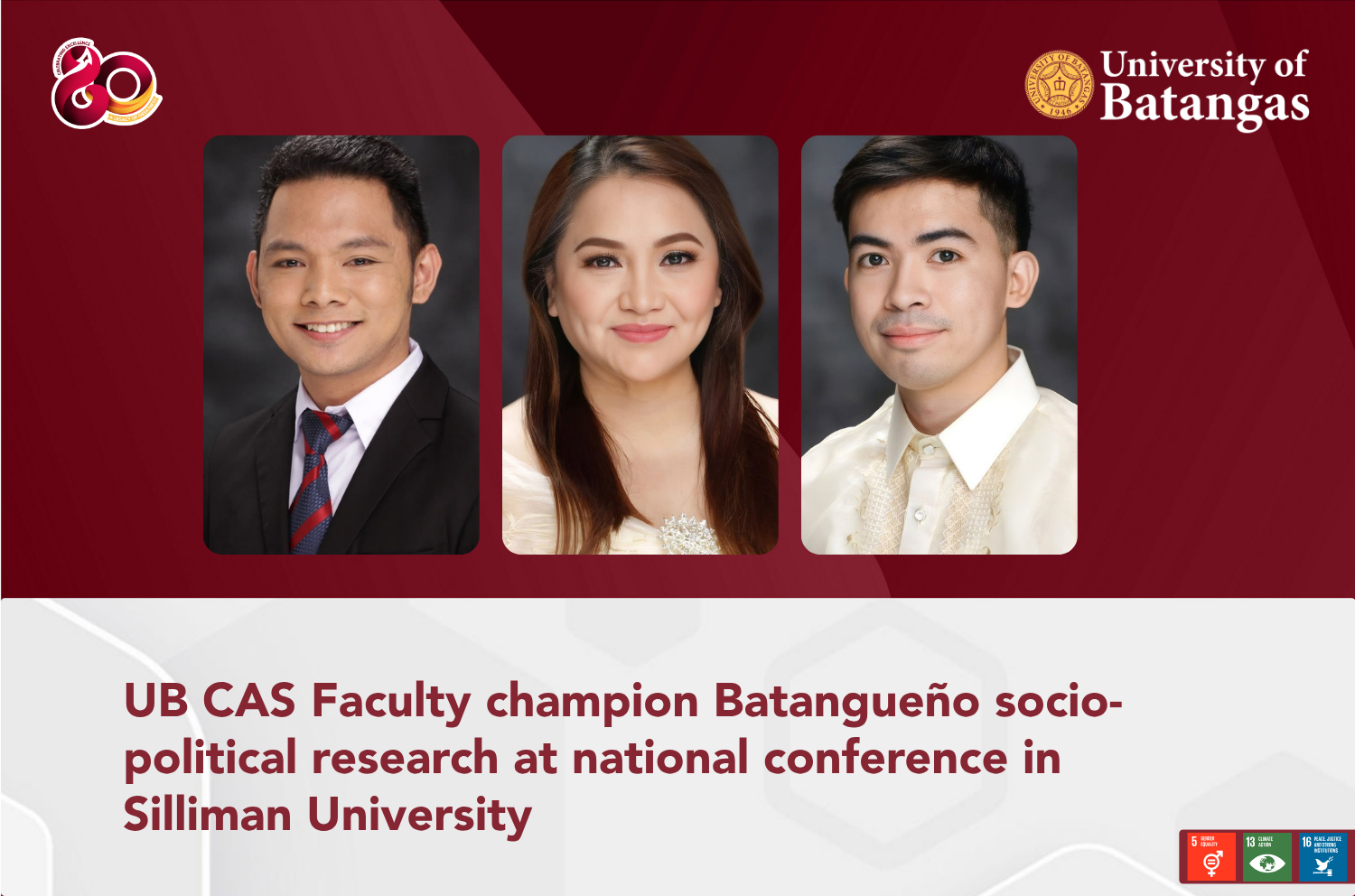
Faculty researchers from the University of Batangas (UB) College of Arts and Sciences (CAS) successfully presented three pioneering research papers at the Philippine Political Science Association conference held at Silliman University in Dumaguete City from April 28 to 30, 2026.
During the three-day convention, the CAS delegation spotlighted distinct sectors of the Batangueño demographic, analyzing gender inclusivity, ecological advocacy, and youth leadership. The faculty scholars delivered the following collaborative research presentations:
Mr. Jerico Jairo T. Reyes presented “Gendered Margins: Batangueña Struggles for Political Inclusion,” a study he co-authored with Dr. Mary Jean P. Alday and Dr. Kristine Amor S. Catequista.
Ms. Elsie O. Untalan delivered “Shifting Tides of Eco-Political Engagement Among Batangueño Youth in Climate Activism,” a collaborative paper she developed alongside Dr. Mary Ann B. Macatangay, Mr. Jericho Jairo Reyes, and Mr. Isaac Navarro.
Mr. Isaac Navarro presented “Generation Z Across the Continuum of Empowerment in Youth Governance,” a study he wrote in partnership with Dr. Mary Ann B. Macatangay, Ms. Elsie O. Untalan, Mr. Jericho Jairo Reyes, and Mr. Abvic Ryan Maghirang.
These scholarly outputs demonstrate how the UB CAS faculty actively investigates the evolving dynamics of civic participation. The presentations provided national scholars with a comprehensive look at how localized grassroots movements in Batangas reflect broader political transformations across the country.
This national academic engagement directly localizes the United Nations Sustainable Development Goals (SDGs) by transforming global frameworks into relevant, localized institutional research:
The presented papers actively drive SDG 5: Gender Equality – specifically aligning with Target 5.5 – as the faculty investigates the structural barriers affecting Batangueña women and highlights their full, effective participation in political leadership. Furthermore, the delegation’s focus on eco-political engagement localizes SDG 13: Climate Action by documenting how regional youth mobilize for environmental awareness and mitigation. Finally, the studies on Generation Z governance support SDG 16: Peace, Justice, and Strong Institutions, directly advancing Target 16.7 by providing data-driven advocacy for responsive, inclusive, and participatory representation of young citizens in local civic structures.