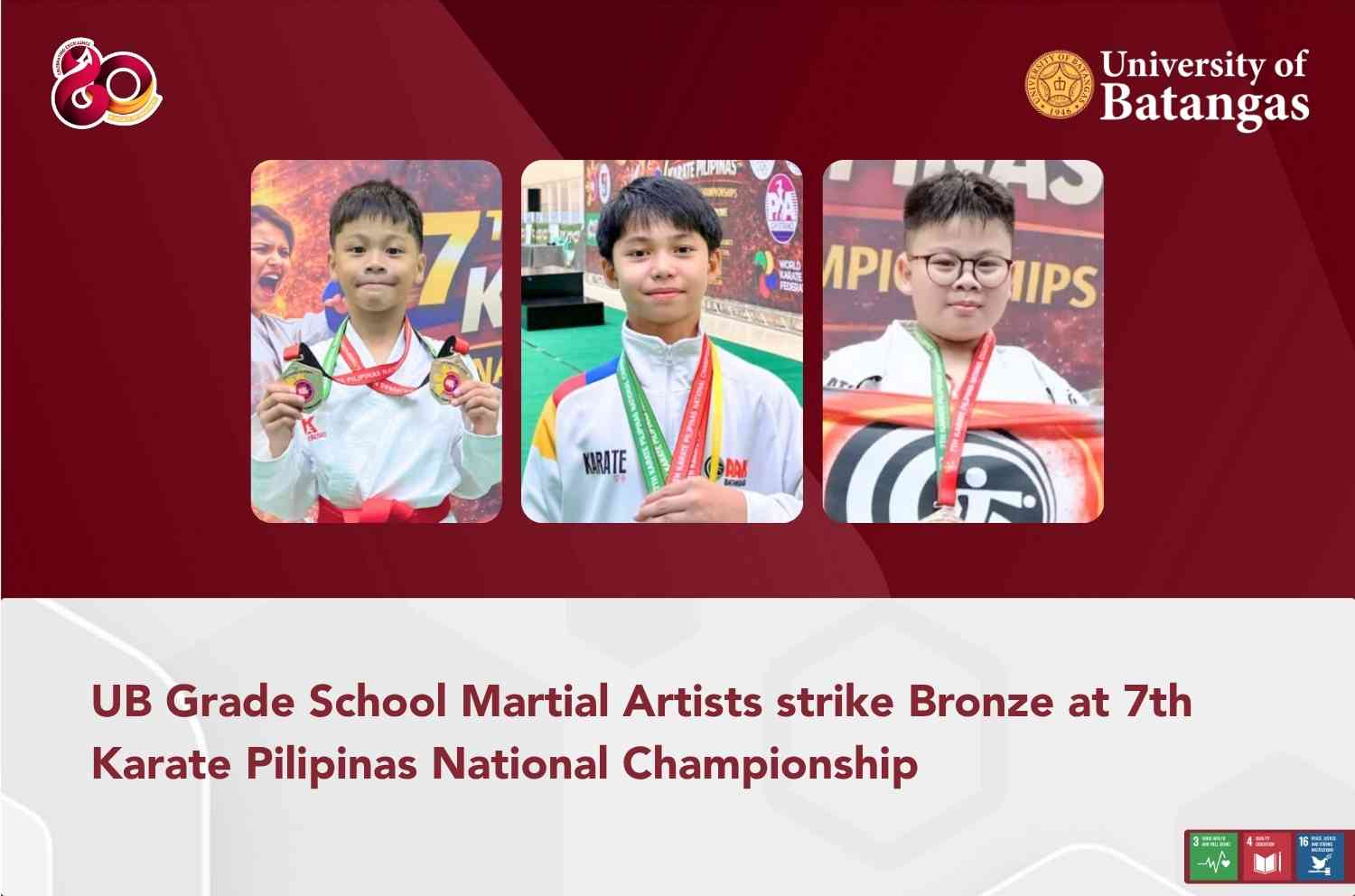
Three young martial artists from the University of Batangas (UB) Grade School Department proved their mettle on the national stage, securing multiple podium finishes at the 7th Karate Pilipinas National Championship. The high-stakes tournament took place from March 6 to 8, 2026, at the Velodrome in Tagaytay City, drawing the country’s most promising karatekas.
These Brahman athletes navigated a field of elite competitors, demonstrating the discipline, focus, and technical precision fostered by the university’s athletic spirit.
Ryu M. Garcia, a Grade 3 student from the Newton section, was hailed as the Grand Champion of Karate Pilipinas 2026 in Kata and Kumite categories. He also captured two Bronze Medals. Competing in the 8-9 Years Old category, Garcia displayed remarkable versatility in both Open Kata (Form) and Open Kumite (Sparring), reaffirming his status as one of the nation’s top young prospects.
In the 12-13 Years Old division, Dean Caleb A. Montalbo from Grade 6 – Palma delivered an impressive performance to secure two Bronze Medals. Montalbo showcased his agility and tactical awareness in the Open Kata and the Under 14 Kumite – 40kg events. His podium finishes reflect the rigorous physical preparation and mental toughness required to compete against older, seasoned opponents.
Completing the university’s medal haul, Martin Genaro P. Liwag from Grade 3 – Thomson earned a Bronze Medal in the 8-9 Years Old Intermediate Kata. Liwag’s performance highlighted his mastery of form and sequence, earning high marks from the national judges for his execution and poise.
The success of these young athletes underscores UB’s commitment to holistic development, where physical education and competitive sports complement academic growth. By supporting participation in national-level championships, the Grade School Department empowers students to build character, resilience, and a deep sense of sportsmanship.
UB links these athletic achievements to the broader mission of the United Nations Sustainable Development Goals (SDGs), recognizing that competitive martial arts serve as a vehicle for societal progress.
Through the promotion of physical literacy and combat sports, the university advances SDG 3: Good Health and Well-being. This initiative encourages active lifestyles and mental discipline among the youth, fostering a generation that values health and physical resilience. Furthermore, the dedication shown by these students aligns with SDG 4: Quality Education. The university views the karate dojo as an extension of the classroom, where students learn essential life skills such as perseverance, respect, and self-control. Finally, by competing fairly on a national platform, these students embody the principles of SDG 16: Peace, Justice, and Strong Institutions, promoting the spirit of non-violence and mutual respect that lies at the heart of traditional karate-do.