
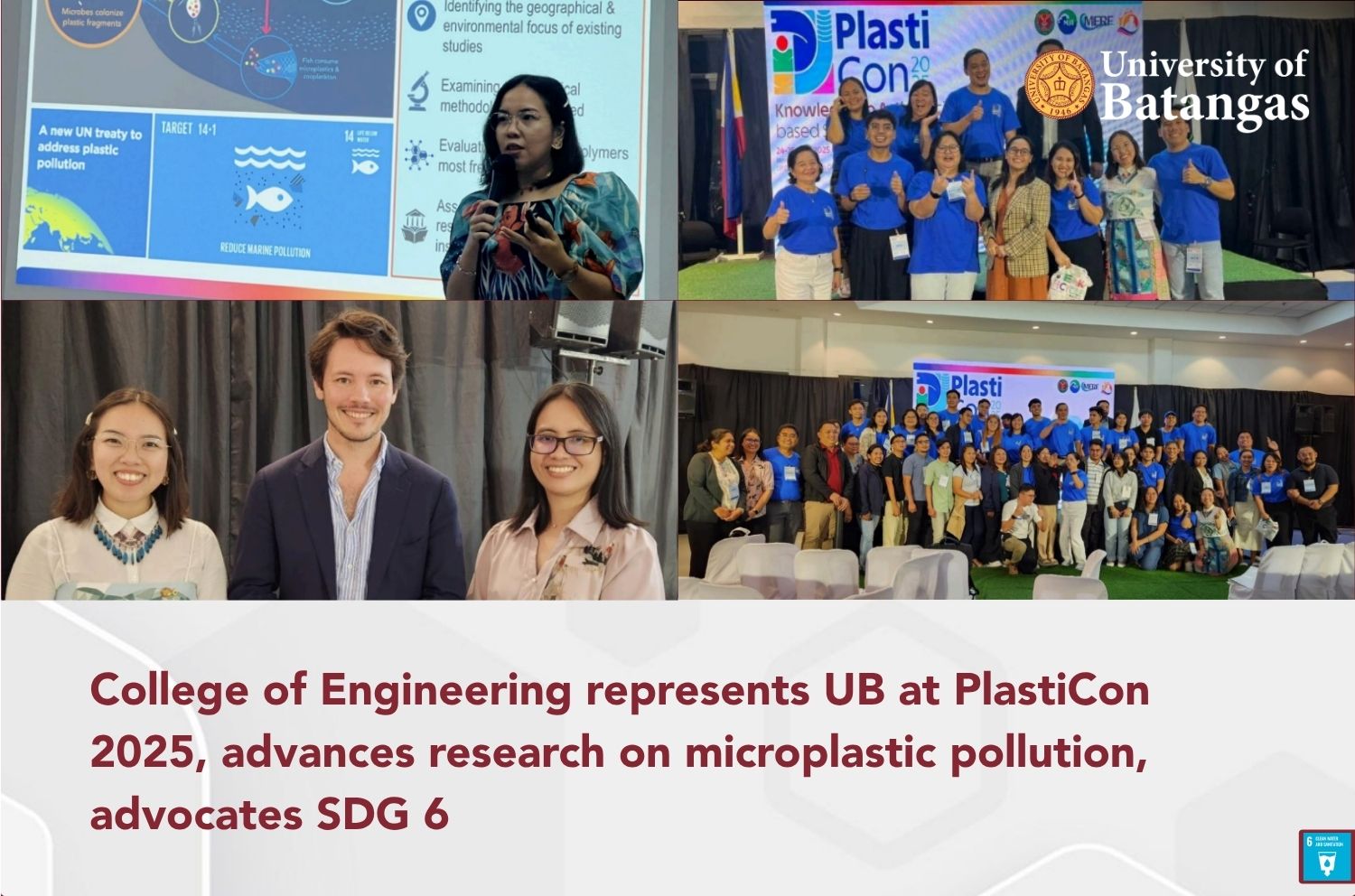
The University of Batangas (UB), through the College of Engineering and the Engineering and Technology Research and Development Office (ETRDO), strengthened its environmental research presence as Engr. SiddArtha Valle participated as an oral presenter at PlastiCon 2025: The National Conference on Plastics, held on July 24–25, 2025, at the Marine Science Institute in UP Diliman, Quezon City.
The conference was organized by PlastiCount Pilipinas in collaboration with the World Wide Fund for Nature (WWF) Philippines, the Department of Science and Technology (DOST), and the UP Marine Science Institute (UP MSI).
PlastiCon 2025 gathered scientists, researchers, industry stakeholders, and government agencies to address the growing plastic pollution crisis in the Philippines. The event highlighted policy directions, scientific innovations, and national research efforts toward sustainable plastic management and a circular economy.
UB participated to contribute to national scientific dialogue on plastic pollution, environmental sustainability, and solid waste management. Engr. Valle presented the research paper “Hidden Threats: Evaluating the Microplastics Crisis and Its Impact on the Philippine Archipelago,” co-authored with Prime-TP research fellows. The study synthesized national microplastic research trends and emphasized the urgent need for standardized baselining, wider ecosystem monitoring, and strengthened institutional collaborations.
Key scientific sessions focused on global and national plastic transport modeling, microplastic detection in Philippine waters, food safety concerns, and emerging technologies for monitoring plastic leakage. Experts from Japan, the Netherlands, and leading Philippine institutions delivered presentations on marine plastic pathways, riverine monitoring, ecotoxicology, and circular economy mechanisms. Government agencies and private sector partners also discussed initiatives on Extended Producer Responsibility (EPR), waste reduction, and community-based sustainability programs.
Engr. Valle’s participation expanded UB’s visibility as an active contributor to national environmental research. The conference provided opportunities for linkages with UP MSI, DOST, WWF Philippines, and other academic institutions, enabling future collaborations in microplastic analysis, waste management, and circular economy initiatives. UB gained insights relevant to embedding microplastic and pollution studies within engineering programs, and to developing a stronger institutional research cluster on sustainability.
PlastiCon 2025 also featured art-based science communication through the Collision exhibit, documentary screenings, and panel discussions with environmental advocates and policymakers. The conference concluded with commitments to deepen research cooperation and integrate science-based approaches into national plastic pollution strategies.