
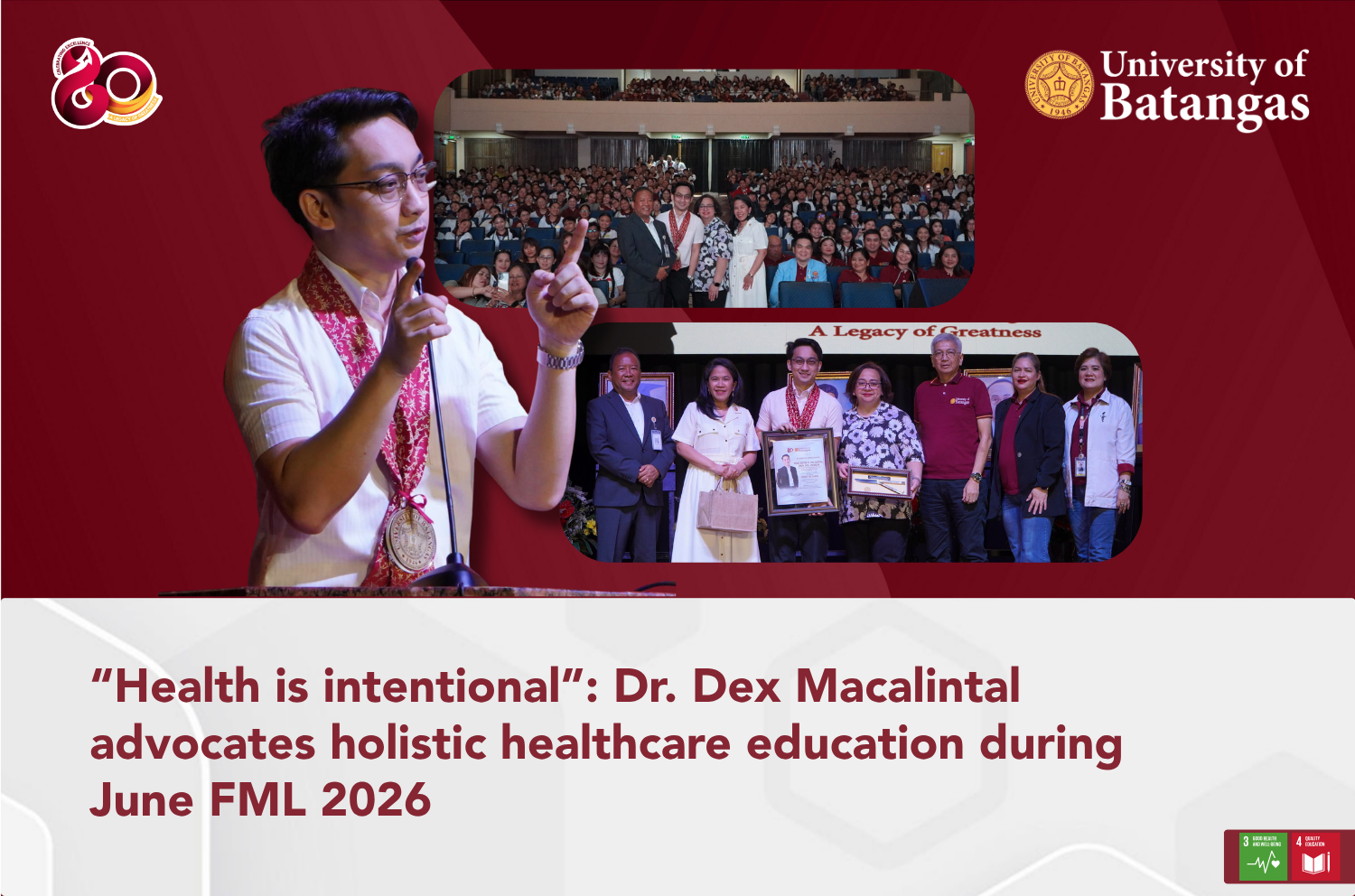
University of Batangas (UB), as part of its celebration of the 80th Founding Anniversary, advocated holistic wellness as it held another Founders Memorial Lecture (FML) 2026 at the Juan Y. Javier Culture and Arts Building – Auditorium on June 26, at 8:00 AM, joining College of Nursing (CoN), College of Allied Medical Sciences (CAMS), and UB Lipa City (UBLC) College of Health Sciences (CHS) with the theme “Holistic Approaches to Health and Wellness.”
UB President Lily Marlene J. Hernandez-Bohn opened the lecture by highlighting the critical shift toward proactive wellness.
“Taking active steps to promote health, prevent disease, and maintain wellness is no longer merely a personal preference, but rather an absolute necessity that empowers individuals to be active, informed participants in their own daily health care,” President Hernandez-Bohn stated.
Following the opening remarks, Dr. Abegayle Machelle P. Chua, Vice President for External Affairs (VPEA) and Dean of CAMS, introduced the guest lecturer, Dr. Marc Dexter Macalintal.
Dr. Chua shared a nostalgic glimpse into the speaker’s past, revealing that hospital staff lovingly dubbed him the “artista intern” during his medical internship. She praised his journey from an inquisitive trainee to a national health advocate with over two million followers, emphasizing his enduring groundedness.
“Success has changed his reach, but it never changed his humility, nor his generosity, nor his willingness to inspire others whenever he is called upon,” Dr. Chua shared.
During his lecture, Dr. Macalintal challenged participants to rethink healthcare by embracing lifestyle medicine as a foundation for long-term wellness. He encouraged the audience to establish a personal “north star” that would guide healthier decisions and sustain positive behavioral change.
Drawing from evidence-based medical practice, Dr. Macalintal identified the essential pillars of health: consuming a predominantly plant-based diet, engaging in regular physical activity, cultivating meaningful social relationships, managing stress effectively, and maintaining healthy sleep habits. He described inadequate sleep and chronic stress as the “hidden saboteurs” of overall health.
He summarized his message through five practical reminders that resonated with participants.
“Eat properly so that you can live longer, move around so that you don’t die right away, avoid stress, my friends, quit smoking, drugs, and alcohol, sleep well, and hope that later tonight, you have someone you love by your side,” he said, drawing laughter from the audience while reinforcing the importance of sustainable healthy habits.
Delivering the synthesis of the lecture, Dr. Abigail Marie U. Hernandez, Associate Dean of the UBLC CHS, emphasized that effective healthcare requires professionals to recognize the interconnected nature of the human body.
“The human body is not just isolated parts, but a beautifully interconnected ecosystem where our thoughts, our environment, our sleep, and of course, the food at the end of our forks are constantly communicating with our cells,” Dr. Hernandez explained.
She noted that the lecture encouraged future healthcare professionals to move beyond conventional disease management and adopt a more comprehensive understanding of health that integrates physical, mental, emotional, social, and environmental well-being.
Concluding the event, Atty. Jesus V. Mayo, Chairman of the Board of Regents, reminded participants that wellness extends far beyond academic preparation and professional practice.
“Health extends beyond mere absence of disease,” Atty. Mayo said. “Health and wellness are lifelong pursuits. By embracing a holistic perspective, we empower ourselves to cultivate energy and inner peace, enabling us to lead a more purposeful and fulfilling life.”
The 2026 Founders Memorial Lecture reflects UB’s continuing commitment to producing competent, compassionate, and socially responsive healthcare professionals who promote wellness alongside clinical excellence. By integrating lifestyle medicine into healthcare education, the university strengthens its mission of preparing graduates who can respond to the evolving health needs of individuals and communities.
The initiative directly advances the United Nations Sustainable Development Goal (SDG) 3: Good Health and Well-Being, particularly Target 3.4, which seeks to reduce premature mortality from non-communicable diseases through prevention, treatment, and the promotion of mental health and well-being. The lecture also supports Target 3.d by strengthening knowledge and capacity to address current and emerging public health challenges through evidence-based health promotion.
The program likewise supports SDG 4: Quality Education, specifically Target 4.7, by equipping future healthcare professionals with the knowledge, values, and competencies needed to promote sustainable development and healthy lifestyles. Through interdisciplinary collaboration among UB’s healthcare colleges, the university continues to cultivate graduates who are prepared to deliver patient-centered care while advancing healthier and more resilient communities.